Injection Molding Defects & Solutions: Weld Lines
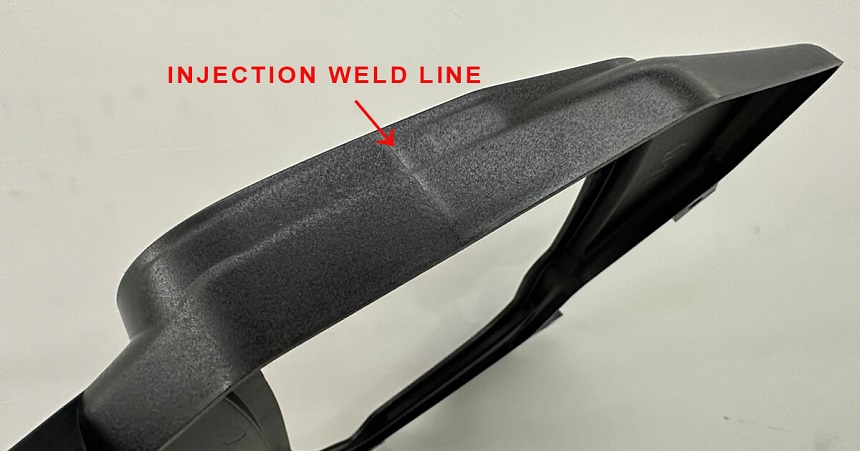
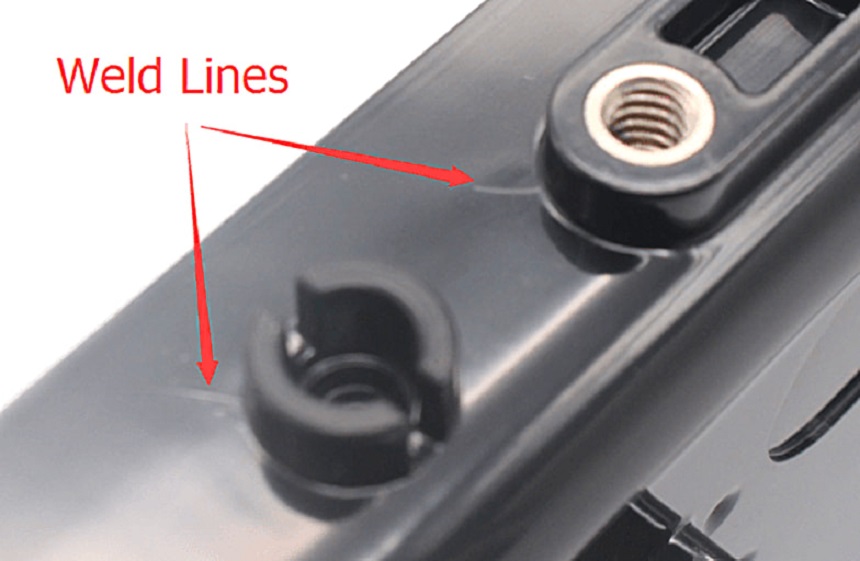
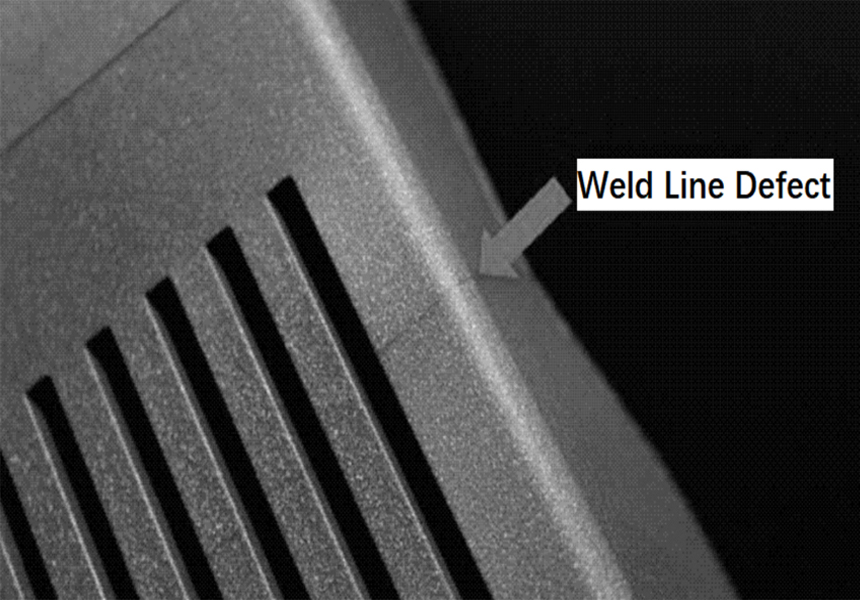
Weld lines, also called knit lines, form where two melt fronts meet during plastic injection molding mass production. If the fronts do not fuse sufficiently, a visible seam can remain on the surface. The line is often more noticeable on high-gloss, dark-colored, or transparent parts. For plastic injection molding parts made by industrial manufacturing, a severe weld line may affect both appearance and mechanical strength.
The first step is to establish whether the line consistently appears in the same location or changes in severity during mass production. For a fixed-location defect, gate arrangement, flow convergence, and local venting should be checked first, rather than adjusting temperature or pressure directly. If the line varies between cycles, process stability should then be prioritized. This distinction provides a useful starting point when discussing corrective actions with a plastic injection molding company.
Low Melt Temperature or Injection Mold Temperature
When melt temperature or injection mold temperature is too low, the advancing melt fronts may cool excessively before they meet. Although the cavity can still fill, the fronts may not fuse sufficiently at the convergence region, leaving a visible boundary.
The relevant condition is the temperature of the fronts when they meet, not simply the temperature setting displayed on the injection machine. The flow path and the location of the meeting region should therefore be considered together with the processing conditions.
Corrective Actions
If the weld line remains in the same location, the flow path and local venting should be reviewed before increasing temperature. A temperature adjustment alone may provide limited improvement when the gate arrangement directs the fronts into an unfavorable meeting region.
After these conditions have been checked, increasing melt temperature and mold temperature may improve fusion. Injection speed can also be optimized to help the fronts reach the convergence region before excessive cooling occurs.
These changes should remain within the material’s recommended processing conditions. Increasing injection speed should not be treated as an automatic solution: the convergence region must also allow air to escape effectively. Temperature, speed, and venting should be evaluated together.
Low Holding Pressure or Insufficient Pressure Transfer
Insufficient holding pressure can limit consolidation where the melt fronts meet. A similar condition can occur when the machine setting appears adequate but pressure is not effectively transmitted to the convergence region.
This distinction matters because increasing the holding-pressure setting does not necessarily produce the same improvement throughout the cavity. The pressure reaching the weld-line area is more relevant than the setting alone.
Corrective Actions
Pressure transfer and the filling-to-holding transition should be checked first, rather than increasing holding pressure repeatedly.
Where insufficient holding pressure contributes to the defect, an appropriate increase may improve consolidation at the meeting region. If the transition from filling to holding is delayed, the changeover point should be adjusted appropriately so that holding pressure can act effectively.
However, switching earlier should not be interpreted as switching as early as possible. The changeover point must correspond to the actual filling condition.
If these adjustments provide limited improvement, the gate arrangement and flow path should be reviewed again. A higher-pressure setting cannot compensate for a flow path that does not transmit pressure effectively to the affected region.
Unsuitable Gate Number or Gate Position
How It Contributes to Weld Lines?
Gate number and position influence the direction of material flow, the location where the fronts meet, and their convergence angle. An unsuitable arrangement may place the weld line on a prominent appearance surface or cause the fronts to meet at a small, unfavorable angle.
The line should therefore be evaluated as the result of a filling pattern, rather than as an isolated surface mark.
Engineering Judgment and Corrective Actions
For a weld line that consistently appears in one area, the gate arrangement should be prioritized before further temperature or pressure changes.
The review should establish:
– Where the melt enters the cavity.
– Which paths the fronts follow before meeting.
– How the fronts approach each other at the convergence region.
– Whether the meeting location lies on a critical appearance surface.
– Whether air can escape from that region.
Optimizing gate position can help move the weld line to a less visible area. The objective is to improve the overall flow arrangement, rather than simply hide the seam without considering how the rest of the cavity fills.
Insufficient Venting at the Convergence Region
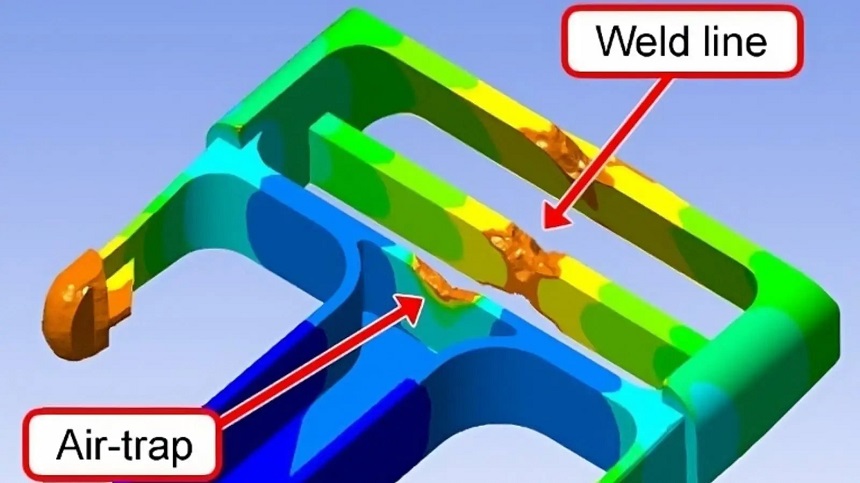
As the melt fronts approach each other, air in the convergence region needs an effective escape path. If local venting is insufficient, trapped air may interfere with fusion and contribute to a visible joining line.
The presence of vents elsewhere in the mold does not confirm that the actual meeting region is adequately vented. Vent location and the final filling pattern need to be considered together.
Engineering Judgment and Corrective Actions
Local venting should be checked before increasing injection speed or pressure when the line repeatedly appears in the same area.
Existing vent paths should first be inspected to determine whether they are obstructed or positioned away from the relevant convergence region. Where necessary, effective venting should be added at the end of the converging flow paths.
If restoring existing vents provides limited improvement, their position relative to the meeting region should be reviewed. Increasing speed without resolving an air-escape problem is not a substitute for effective venting.
The corrective approach should connect temperature, pressure transfer, gate arrangement, and venting. The aim is to improve fusion where the fronts meet and, where the mold design permits, move the weld line away from critical appearance areas. A less visible seam should not automatically be taken as proof that the mechanical-strength concern has also been resolved.