Sink Marks in Injection Molded Parts: Causes and Fixes
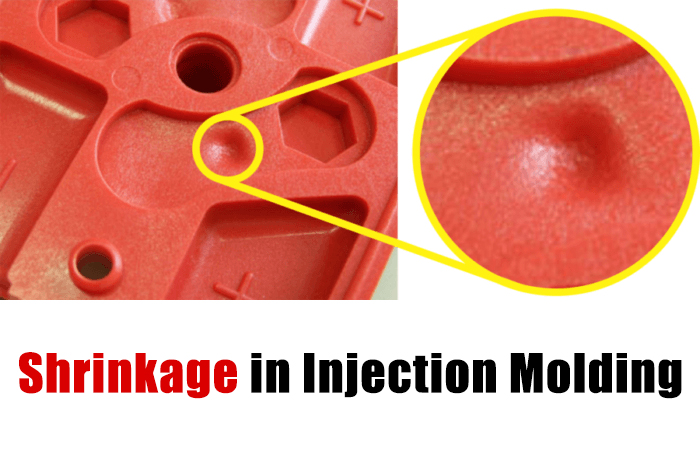
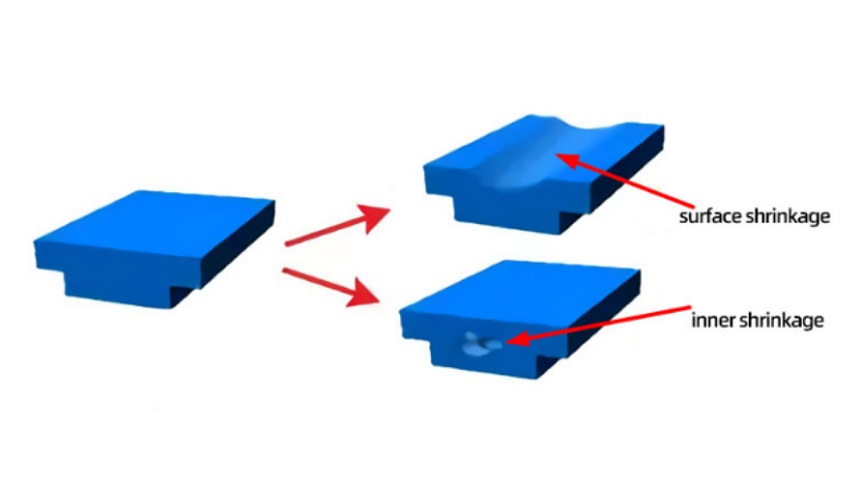 Sink marks are localized depressions on the surface of a plastic molded part. They commonly appear in thick-wall sections, behind ribs, at the base of bosses, or in areas where material accumulates. Although they are often treated as cosmetic defects, sink marks can also indicate that a local area has not received enough material during packing and cooling.
For injection molded parts, the first question is not simply whether holding pressure is high enough. The location of the sink mark should be checked first. A mark behind a rib, around a boss, or in a thick section often points to a local wall-thickness or feeding issue before it points to a general process-setting issue.
What Sink Marks Look Like?
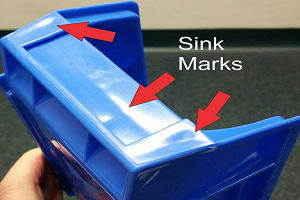
A sink mark is an inward depression rather than excess material on the surface. It may be shallow and visible only under reflected light, or deep enough to be felt by hand.
Common locations include:
- The visible side opposite a rib
- The visible side opposite a boss base
- Thick-wall sections
- Areas with abrupt wall-thickness transitions
- Regions where several ribs, bosses, or structural features are concentrated
Severe shrinkage can also result in reduced part weight because the affected section was not fully packed before cooling was complete.
Cause Analysis
1. Excessive Local Wall Thickness
Thick sections cool more slowly than surrounding thin sections. As the internal material continues to cool and shrink, it needs additional material to compensate for volume loss. If packing is insufficient, the outer surface may be pulled inward.
This is why sink marks frequently appear behind ribs and around bosses. Even if the visible face of the part is flat, the structure behind it can create a heavy local section.
Rib thickness should be evaluated carefully. A common design starting point is to keep the rib base at approximately 50%–60% of the adjacent nominal wall thickness, then validate the result through material selection, part geometry, and mold trials.
2. Abrupt Thickness Transitions and Material Accumulation
A sink-mark risk increases when a thick section is connected directly to a much thinner section. The thin section freezes earlier, while the heavy section continues shrinking.
Closely spaced ribs, multiple boss features, and sharp internal geometry can also create an unintended thick area. Instead of evaluating each feature separately, the combined material concentration around the visible surface should be reviewed.
3. Insufficient Packing or Early Gate Freeze-Off
Holding pressure and packing time are intended to compensate for shrinkage after the cavity is filled. If holding pressure is insufficient, not enough material enters the affected area during cooling.
Packing time also matters only while the gate remains open. Once the gate freezes, the cavity can no longer receive additional material. If the thick section continues shrinking after gate freeze-off, sink marks can develop even when holding pressure has been set at a higher level.
4. Uneven Cooling
Uneven cooling can increase local shrinkage differences. A thick section that stays hot longer than surrounding areas may continue shrinking after the rest of the part becomes more stable.
The cooling layout should therefore be reviewed around thick-wall regions, boss bases, rib clusters, and other locations where sink marks repeatedly occur.
5. Gate Location and Packing Path
A gate must provide an effective packing path to the sections that require compensation. If a thick area is too far from the gate, or if the gate is too small and freezes too early, packing effectiveness can be limited.
When sink marks remain concentrated in one thick section, gate position, gate size, runner layout, and the distance to the affected area should be reviewed together.
Corrective Actions
For Part Designers
- Maintain wall thickness as uniformly as practical.
- Reduce unnecessary material accumulation behind cosmetic surfaces.
- Review rib and boss thickness in relation to the adjacent nominal wall.
- Avoid combining multiple structural features into one heavy local section.
- Reduce abrupt transitions between thick and thin areas where possible.
For Mold Engineers
- Position the gate to support effective packing of thick-wall regions.
- Review gate size and gate freeze-off behavior during mold trials.
- Balance the cooling layout around thick sections and high-mass features.
- Confirm that the runner and packing path can feed the affected area effectively.
For Process Engineers
- Increase holding pressure and packing time as needed to improve shrinkage compensation before gate freeze-off.
- Confirm that packing remains effective until gate freeze-off.
- Ensure sufficient cooling before ejection.
- Adjust process settings only after reviewing whether the part geometry and feeding path can support effective packing.
Engineering Judgment
When sink marks appear behind ribs or at the base of bosses, begin with the local part geometry. Raising holding pressure may reduce the visible defect, but it may not fully resolve excessive local thickness or material accumulation.
If part geometry is reasonable but the defect remains, review packing conditions and gate freeze-off. If packing adjustments have limited effect, evaluate cooling balance and the gate-to-thick-section feeding path.
Sink marks should therefore be addressed in this order:
- Local wall thickness and feature concentration
- Holding pressure, packing time, and gate freeze-off
- Cooling balance
- Gate location, gate size, runner layout, and packing path
Frequently Asked Questions
Q1: Are sink marks and vacuum voids the same defect?
No. Sink marks are visible surface depressions, while vacuum voids are internal cavities. Both can be related to material shrinkage and insufficient packing, but they appear in different locations.
Q2: How thick should a rib be to reduce sink-mark risk?
A common starting guideline is approximately 50%–60% of the adjacent nominal wall thickness. The final rib design should still be validated based on the material, part geometry, and mold-trial results.
Q3: Will higher holding pressure always eliminate sink marks?
No. Higher holding pressure can improve packing, but it cannot fully correct excessive wall thickness, early gate freeze-off, uneven cooling, or an ineffective packing path.
Q4: Why does gate freeze-off matter?
Once the gate freezes, material can no longer enter the cavity. If a thick-wall section continues shrinking after that point, there may be insufficient material available to compensate for the shrinkage.
Q5: Should sink marks be solved during design or production?
Both stages matter, but local wall thickness, rib design, boss design, and feature concentration should be addressed during part design whenever possible. Process adjustments are then used to optimize packing and cooling during plastic injection molding mass production.